
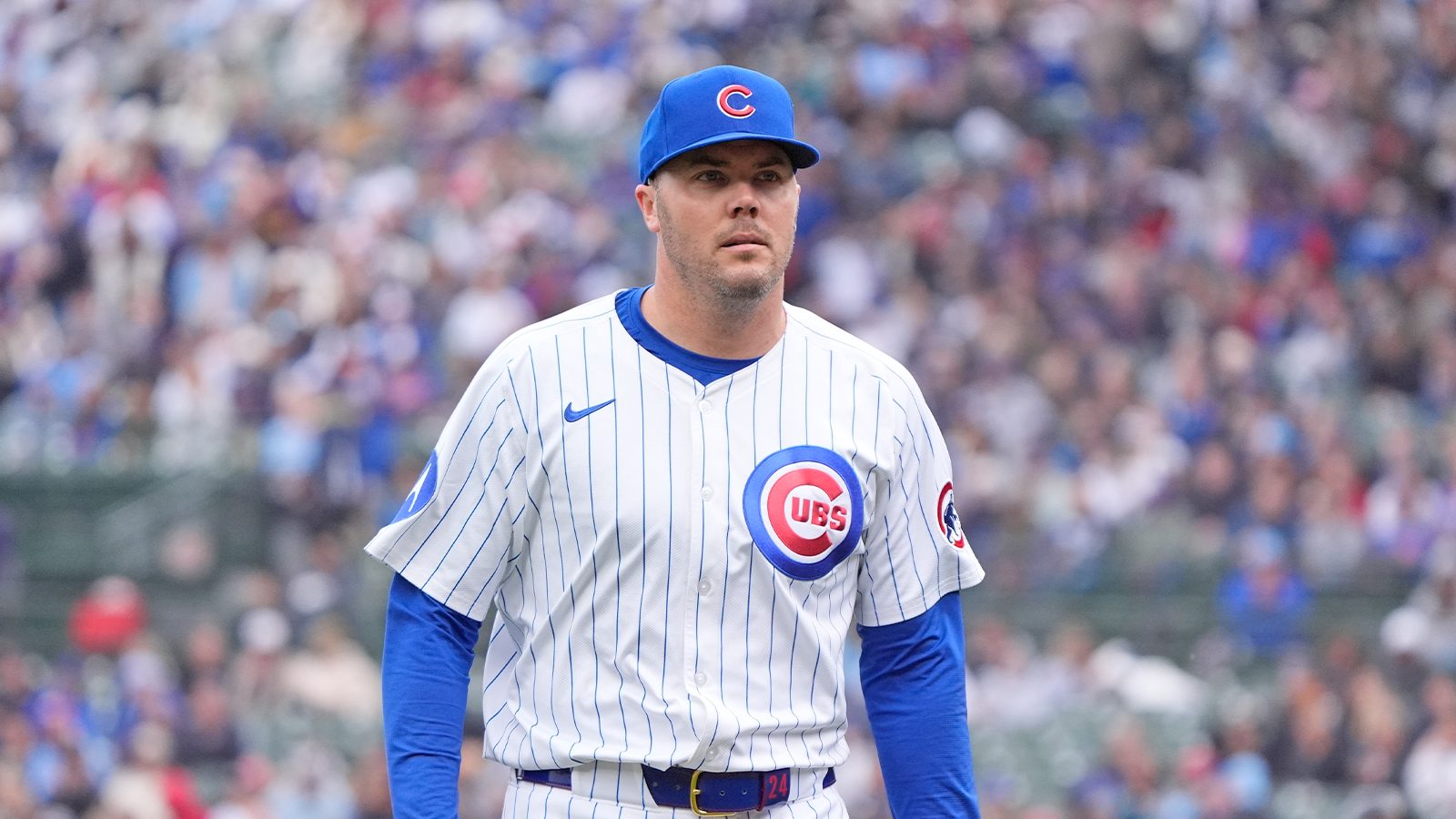
Photo by Andy Martinez, Marquee Sports Network
Lefty reliever Caleb Thielbar has signed a one year contract worth $4.5 million with the Chicago Cubs. This comes after Caleb posted an outstanding 24-25 season with the Northsiders. This now adds a second lefty to the Cubs’ bullpen with the earlier addition of Hoby Milner (one year, $3.75 million).
Contract Details
Caleb Thielbar signed his contract with the Chicago Cubs; one-year, $4.5 million guaranteed. This includes a base $4 million salary for 2026, with a $500,000 buyout for a mutual option in 2027. According to The New York Times, the contract also includes performance bonuses that are, as of right now, are unspecified. This comes after he signed a one-year $2.75 million contract last offseason; his first time away from the Minnesota Twins. The Cubs front office has generally shied away from handing relievers multi-year contracts, and Thielbar is no exception, especially since he is due to turn 39 in 2026.
According to FanGraphs’ and BaseballReference’s respective metrics, Thielbar posted a 1.1 Wins Above Replacement (WAR) in 2025. This puts him in line with the industry standard of $4-8 million per WAR, and given his age it’s easy to see why the Cubs (and other teams) were hesitant to hand him a longer/larger contract. While I love this deal for the Cubs for many reasons that we’ll get into down below, the question remains: Is Caleb Thielbar worth his contract? Let’s dive into his numbers.
2025 Performance
Caleb Thielbar was one of the mainstays of a Cubs’ bullpen that dealt with a handful of injuries to its arms in 2025. While all bullpens are prone to injuries over the course of a 162 game season, Thielbar’s presence helped to settle a pen that worried most fans early in the season. He proved capable of handling whatever task was thrown at him, and over the stretch he performed well as a trusted set-up man and occasional closer. Craig Counsell calls his relievers “out-getters,” and Thielbar proved more than capable of getting outs when it mattered most.
He particularly thrived in left-on-left matchups, but still posted a sub-1.00 WHIP against all hitters. He was in the 90th percentile or above in xERA, xBA, and Breaking Ball Run Value, while also slotting into the 97th percentile in Hard-Hit percentage which proves he can consistently induce weak contact; a skill sought after by the Cubs’ front office due to their exceptional defensive play. Speaking of the Cubs’ fielding, Caleb’s FIP hovered right at 3.00; which is on pace with pitchers like Tarik Skubal and Yoshinobu Yamamoto. He doesn’t necessarily need a good defense to be an effective pitcher.
While Thielbar is not your typical ground-ball pitcher (37th percentile), his ability to induce soft contact and miss barrels is valuable to any MLB team. He didn’t give up many home runs, limited his walks, and averaged around one strikeout per inning; all great signs for an MLB reliever. If we want to touch on his ERA (an outdated stat that, in my opinion, proves to be more useful as an expected statistic), he posted an impeccable 2.64 across the entire season (147 ERA+). His performance exceeded everyone’s expectations and it’s easy to see why the Cubs wanted him back.
Pitch Repertoire
Thielbar pairs an average four-seam fastball with a devastating curveball while also working in a sweeper/slider to keep hitters off balance. In an era where high leverage arms are almost always required to have a triple digit fastball, Thielbar goes against the grain. His fastball sits below league average and doesn’t have much movement to it; I’d personally consider it his worst pitch (.226 BA, .398 SLG, .298 wOBA). But while Thielbar isn’t a flamethrower, he uses his breaking stuff to devastating effect. He uses his curveball effectively against right-handed batters, and relies more on the sweeper/slider against lefty hitters. While he does post better overall numbers against lefties, Thielbar’s curveball held opposing batters to a .172 wOBA and a .231 SLG, while also inducing a 35% whiff rate. This particular pitch has more drop than league average, which helps to offset a fastball that can run flat at times. This curveball allows Thielbar to face right-handed hitters with confidence, and it proves to be his most valuable pitch particularly in tough matchups against opposite handed batters.
When getting an easier matchup against lefties, his sweeper/slider combo does the job quite well. His sweeper, a slow moving frisbee-like pitch, proved effective in limiting contact but could get hammered if left in the zone (.143 BA vs .286 SLG). His slider, thrown with more velocity and less break, reduces the potential for extra-base hits (.237 SLG) and has a much higher whiff rate than its slow-moving cousin (33.8% vs 23.1%). Both pitches used in tandem proved to be a lethal combination to keep left-handed hitters off balance and prevent them from sitting on his fastball. His strikeout and walk rates were well above league average, showing his ability to locate his pitches consistently. Overall, while not an overpowering pitcher, Thielbar understands at this point in his career that he never will be. He doesn’t need to be. His stuff is what makes him an effective reliever, and he uses it to great effect.
It is also important to note that Caleb Thielbar has a unique arm slot, particularly when compared with his left-handed bullpen mate, Hoby Milner. Thielbar’s 56 degree arm angle is one of the highest release points in the league for a left-handed hurler. Only 5 other pitchers with more than 100 pitches thrown had a greater arm angle than Thielbar in 2025, and he’s on par with the likes of Clayton Kershaw and Blake Snell. Combine this with Hoby Milner’s league leading -6 degree arm angle, and the Cubs have two left handers that can give opposing batters completely different looks.
2026 Outlook
We already know that Caleb Thielbar had an exceptional 2025 season, but is this likely to continue into 2026? While it can be hard to predict year-over-year performances for pitchers, particularly relievers, we can look at his expected statistics as well as his projections to get a gauge for his outlook. First and foremost, we can look at his expected numbers from 2025, which are good predictors of future performances. As stated previously, his xERA was in the 98th percentile and his xBA was 92nd percentile; pretty good so far. While his xwOBA was 10 points higher than his actual wOBA, it’s not enough of a difference to worry me as they are both well above league average. In terms of pitch repertoire, his fastball and slider were expected to be slightly better than they actually were, while his curveball and sweeper were expected to regress closer to league average. His sweeper in particular seems to have defied the odds in 2025. In regard to FIP, again Caleb was expected to see some regression with an added 68 points. Overall, the expected statistics seem to predict that Thielbar is expected to slightly regress but still contribute as an effective reliever.
What do the projection systems say? For this, we will use Steamer and MARCEL. His 2026 Steamer numbers do seem to convey the same sentiment as his expected statistics: ERA = 3.75, FIP 3.87, WHIP = 1.25. While he is expected to strike out slightly more batters, he is projected to walk more than one more batter per 9 innings, and his HR/9 is projected to go up as well (1.16 compared to 0.78 in 2025). I would assume that much of this is due to the fact that Thielbar will be 39 years old in 2026, and many of these projection systems come with a hefty age regression formula. The MARCEL formula from BaseballReference’s website uses their age regression formula, and they also don’t forecast Thielbar as kindly as his expected statistics do. For ERA, it’s even worse than Steamer at 3.97 for 2026. His SO/W ratio is projected to drop down to 2.80, WHIP is slightly kinder than Steamer at 1.22, and he’s expected to give up two more home runs than he did in 2025 with one more inning pitched.
Conclusion
This is where a dilemma comes in. Will Thielbar perform more closely to his expected statistics from 2025, or will he follow the projected metrics from Steamer and MARCEL that seem to be heavily influenced by his age? Only time will tell, but I predict Thielbar to sit somewhere in the middle. Will he be as effective as he was last year? Due to his age, an expected regression to the mean, and adjustments made by opposing batters, I expect not. However, I do believe that he will still be an effective left-handed reliever in a bullpen that lacks quality left-handed arms (for the time being). While he may not prove to be a shutdown closer or setup man, the Cubs have other options including Daniel Palencia and Porter Hodge (who both had struggles in 2025), along with the likelihood of adding other arms in free agency.
I return to the question posed at the beginning of this article: Is Caleb Thielbar worth his (projected) contract? I would say yes. In an age where quality relief pitching is getting more and more expensive (just look at some of the contracts handed out to guys like Edwin Diaz, Devin Williams, and Robert Suarez), signing Thielbar to a one year deal worth $4.5 million is certainly a good thing for the Cubs in my eyes. Only time will tell how Thielbar’s 39 year old body will hold up in 2026, but I’m certainly glad to have him back in a Cubs uniform for that price.
All statistics and metrics were pulled from FanGraphs, Baseball Reference, and Baseball Savant unless otherwise noted

Leave a comment