
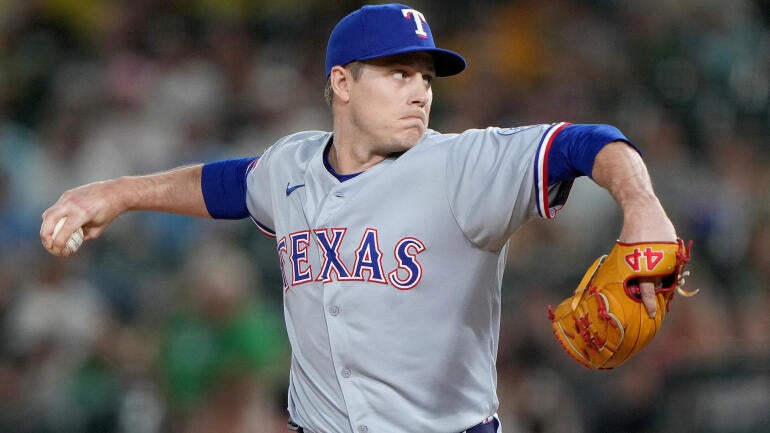
The Chicago Cubs have signed right-handed reliever Phil Maton to a two-year contract worth $14.5 million guaranteed. Maton, 32, spent the 2025 season with the Cardinals and Rangers and posted a 2.76 ERA with a 33% strikeout percentage.
Contract Details
Phil Maton’s contract is worth $14.5 million over two years. Maton will earn a base salary of $5.5 million in 2026, and a base salary of $6 million in 2027. The contract also includes incentives for 40 and 50 appearances, worth $125,000 each. The contract also includes a 2028 club option worth $8.5 million, as well as incentives for 40 and 50 appearances worth $250,000 each. If the Cubs decline their 2028 option, the buyout would be $3 million.
With Maton’s contract, the Cubs have broken from their usual protocol of handing out one-year deals to relief pitchers. Maton, who is scheduled to turn 33 in March, gets handed a two-year contract. It’s easy to see why the Cubs wanted to sign Maton for multiple years, as he has been a reliable reliever over the last few years. He has also been able to stay healthy for a large majority of his career; he’s pitched more than 60 innings in each of the last 5 seasons. As is the norm for us here at Windy City Whistle, we go by the general guideline that relievers can expect to earn anywhere between $4-8 million per WAR (Wins Above Replacement). In 2025, Maton posted an fWAR of 1.5 and a bWAR of 1.3, which gives credence to his average annual salary of $7.25 million.
While Phil Maton’s contract doesn’t break the bank, it’s pertinent to ask two questions. First, what are the expectations for his 2026 performance? Second, is he worth his contract that makes him the highest paid bullpen arm on the Cubs roster (for now)? We’ll dive into the numbers below to see what we can expect from Maton in 2026, and whether or not his contract is club friendly.
2025 Performance
Phil Maton’s performance in 2025 was impeccable. As I always tend to start with comparing a player’s performance with his peers, let’s look at how Maton stacked up against other hurlers last year using Baseball Savant’s Percentile Rankings. In terms of run value, he was 82nd percentile overall (59th in Fastball RV, 91st in Breaking RV, and he doesn’t offer an off-speed pitch). While these numbers show that he’s able to use his breaking stuff to complement a well-above average fastball, his other metrics are even more astonishing. His Average Exit Velocity and Hard Hit Percentage are in the 99th percentile, His Barrel Percentage and Whiff Percentage are both 98th percentile, and he sits in the top 10% of pitchers in the following categories: xERA, xBA, K%, and Extension. While most of his numbers here are well-above the MLB average, he does sit in the bottom 3rd percentile in Fastball Velo (a trait that seems common among the Cubs’ signings this offseason), and bottom 22nd percentile in walk rate.
What does all of this mean so far? For one, Maton does a fantastic job at limiting solid contact and extra-base hits (xSLG is 99th percentile). His HR/9 sits at 0.44, meaning he’s able to consistently keep the ball in the park. Here at Windy City Whistle we believe that home runs are thrown, not hit, so this is a great trend to see in a relief pitcher. Not only does he limit hard contact, he also has bat-missing stuff as evidenced by his K% and Whiff%. While he has an ability to pitch to contact and minimize damage, he doesn’t need to because he can consistently strike out batters (32.5%). Most MLB pitchers are one or the other, but Maton can do both. His low fastball velocity doesn’t necessarily concern me and we’ll touch on that in more depth in the Pitch Repertoire section.
One of Maton’s weaknesses is that he has a slight tendency to walk batters, as evidenced by his 9.6% walk rate. However, this again doesn’t concern me as he strikes out nearly a third of the batters that he faces. This gives him a K-BB% of 23.4% which is on par with pitchers like Devin Williams and Paul Skenes. Maton’s FIP also sits at 2.60, which is lower than his ERA of 2.79; this tells me that he may be getting slightly unlucky when it comes to the outcomes of his batted balls and that he’s able to limit the amount of home runs he gives up, which is essential for a pitcher with a higher walk rate than most. Speaking of Maton’s ERA and FIP, his ERA- (which accounts for park factors and league average; centered on a scale of 100) was 68, indicating that he was 32% better than league average. His FIP- was even better sitting at 63. I particularly love ERA-, because of the fact that it accounts for park factors, and also compares pitchers to their peers which is essential when evaluating a player on a year-to-year basis.
Overall, Maton’s statistics show an incredibly well rounded pitcher who had an outstanding 2025. His metrics seem to indicate that he’s on track to repeat this performance in 2026, but we’ll focus on that more a little later on in this article.
Pitch Repertoire
First and foremost, let’s take a look at the two fastballs that Phil Maton offers. He predominantly relies on his cutter, which he throws 36% of the time. This offering sits at around 90.6 mph on average, which is just slightly faster than the average cutter thrown by all right-handed pitchers in 2025. Maton’s cut fastball has a few more inches of ride than an average MLB cutter as well. For how often he throws it, he’s able to limit the damage that hitters do. Opposing batters hit .215 against the pitch, with a SLG of .308 and wOBA of .282; however, all of the expected statistics here are lower which suggests he’s getting slightly unlucky with this pitch. Maton also offers a sinker, which he throws only 12% of the time (his least used pitch). His sinker is far slower than MLB average (89.6 mph vs 94.1 mph), and sits around MLB average in terms of induced movement. This leads to the offering getting hit harder than his cutter; BA = .278, SLG = .333, wOBA = .361. However, unlike his cutter, the expected statistics are far worse and indicate that his sinker should be getting hammered even more (xBA = .361, xSLG = .534, and xwOBA is a whopping .452). It’s no mystery why the sinker is Maton’s least used pitch, and it’s best used as a way to keep hitters from sitting on his cutter since the pitches break in opposite directions, making it difficult for opposing batters to square up.
While Maton doesn’t offer an off-speed pitch, he does throw two breaking pitches. The best pitch in his arsenal is his curveball, which is also his most used pitch (38.2% usage). It’s not your typical 12-6 curve, but instead has more glove-side break than league average and can sometimes bleed into a slurve. He’s able to spin the pitch incredibly well and gets a mind-boggling 3200 rpms on average. The incredible spin rate produces a pitch that averages almost 22 inches of glove-side break, and 12 inches of vertical drop. It doesn’t take a rocket scientist to understand why hitters whiff on the pitch nearly 42% of the time, and why it’s his most effective putaway pitch at nearly 30%. This is also evidenced by the lack of damage hitters do against the pitch; BA = .136, SLG = .227, wOBA = .209. There isn’t a large difference between the expected statistics and the actual statistics of the pitch. Maton’s other breaking ball, a sweeper thrown marginally harder than league average, isn’t nearly as effective and it’s evident in his usage of the pitch (14%). He doesn’t get as much movement on the pitch as his peers do, indicated by the fact that his sweeper has 6 less inches of vertical drop and about 4 less inches of glove-side break. While hitters do whiff nearly a third of the time on the pitch, when they make contact it can be devastating as evidenced by the metrics; BA = .400, SLG = .600, wOBA = .453. Compared to his other pitches, these numbers certainly stand out but I’d like to highlight the fact that his expected statistics show he may be getting incredibly unlucky due to the small sample size caused by his pitch usage; xBA = .264, xSLG = .450, xwOBA = .335
In terms of platoon splits, Maton has been predominantly deployed against right-handed batters, but does get a fair amount of usage against lefties; 138 RHB faced vs 110 LHB faced. He uses all four pitches against left-handed and right-handed batters alike. In general, he has about a 50 point advantage in BA, SLG, and wOBA when facing right-handed hitters instead of lefties, and most of his walks come against left-handed hitters even though he tends to face them slightly less. While he’s capable of pitching to all hitters effectively, he certainly thrives against righties.
In particular when evaluating a pitcher I like to look at his pitch usage in 2-strike counts and full counts, because it tells us what pitch he’s most comfortable throwing. In Maton’s case, the usage in these counts generally follows his overall pitch usage. In 2-strike counts, he throws a curveball 56.5% of the time and his cutter gets used 37% of the time, while occasionally mixing in a sweeper (3.5%) and sinker (2.9%). In full counts, the curveball has a usage of 47.8% and the cutter still gets used 37% of the time, while also mixing in the sweeper slightly more often (8.7%) and sinker (6.7%). This tells me that while his putaway pitch in two-strike counts is the curveball, he can hesitate to use it in full counts at times. This is most likely due to Maton not wanting to risk his curveball missing the zone and walking the batter, although he’s still confident throwing it as it’s still his most used pitch in 3-2 counts. While hitters can expect a curveball to be thrown almost half the time in full counts, they still have to respect his other pitches.
2026 Outlook
As is my norm for predicting future performances, I like to look at expected statistics from the previous season, as well as utilizing a couple of different predictive models like Steamer and MARCEL. For pitchers in particular, looking at K-BB% can also be a great predictor of future performances.
Maton’s expected statistics from 2025 were off the charts. We mentioned earlier that his xBA and xERA were both above the 90th percentile mark. Both good signs that we can expect a solid performance out of him in the 2026 season. His xFIP is higher than his FIP, but it’s important to note that xFIP calculates home runs as 10.5% of the fly balls that a pitcher induces. Since I believe a pitcher is generally able to control how many home runs he gives up, I tend to not put too much emphasis on xFIP and its static estimate of home runs. Looking at Maton’s K-BB% at 23.4%, which was the 20th best among qualified relievers last year, we can estimate that he has a high likelihood of reproducing his stellar 2025 season.
In terms of projection models, let’s take a look at Steamer first. Overall, the Steamer model predicts a pretty drastic regression to the mean for Maton, who is due to turn 33 during the upcoming season. His ERA is projected to inflate by more than 1.00, his FIP has an even inflated projection at 3.96, and his K-BB% is expected to drop to 15%. This seems like a pretty drastic increase to me, and these projections may be heavily impacted by his slightly underwhelming 2024 campaign. It’s true that 2025 was Maton’s best season to date, but Steamer seems to predict him to regress closer to his performances from the 23/24 seasons. Perhaps most notably, Steamer predicts Maton to give up over one home run per 9 innings, which would be the most since his 2022 season when he had a 1.37 HR/9. The MARCEL projection system seems to be slightly kinder to Maton, but also predicts some regression to the mean. His ERA is predicted to jump up to 3.63, his HR/9 is expected to sit near 0.87, and while his BB/9 is expected to stay the same, his K/9 projection closely resembles Steamer’s at 9.4 K/9. It’s important to note that MARCEL’s projections have a reliability of 56%, which leaves 44% of the forecast due to regression to the mean.
With all of this taken into account, it’s likely that we won’t see Phil Maton replicate his stellar 2025 season. As stated previously, his 2025 campaign was the best of his career and we can be sure that opposing teams will be making adjustments throughout the offseason and into the season. However, I believe that Steamer and MARCEL have put a little too much emphasis on regression to the mean for Maton. At 33 years old, Maton has a repertoire that works for him, and I believe he leaned into it heavily during the 2025 season. There’s no reason for him to change himself this late into his career, and I believe this works to his advantage. He can focus on his strengths and doesn’t have to worry about developing a new pitch or tweaking his mechanics. I believe this to be one of the many reasons for his stellar performance last year, and I expect the Cubs to not ask Maton to do anything that he isn’t comfortable with at this stage in his career. While yes, he is due for a regression, I don’t think it will be as drastic as the projection systems seem to think it will be.
Conclusion
Phil Maton is the first reliever to get a multi-year contract from the Cubs this offseason (2 years, $14.5 million). After his 2025 campaign, it’s easy to see why. He was one of the best relievers in baseball last year and provides the Cubs with bat-missing stuff, which is something the bullpen generally lacks at this point in time. While he has a tendency to walk batters (something I believe the Cubs pitching staff can work with), his high strikeout numbers and ability to limit the amount of home runs he gives up helps to offset the extra baserunners. While it may be unwise to think that he will replicate his stellar performance from last season, his contract shows us that the Cubs didn’t sign him to be a star high-leverage closer. They signed him to be a swing-and-miss master that is able to effectively deal with right-handed hitters while being versatile enough to handle any role the Cubs choose to give him.
I return to the questions posed at the beginning of this article. We’ve already touched on what we can expect from Maton during the 2026 season, and so we’ll focus on whether or not he is worth the contract the Cubs gave to him. At an AAV of $7.25 million, he is not paid to be on par with high-leverage closers like Edwin Diaz and Josh Hader. Instead, his contract puts him with the likes of Michael Soroka, Matt Strahm, and Steven Matz. For this reason, I think the Cubs did an incredible job in signing Phil Maton to his current contract. In my opinion, he has the potential to outshine all of the other relief pitchers in his contract range. Even if he doesn’t perform to the level that he did in 2025, the value of his contract is incredibly club friendly and reduces risk in case he has a drastic regression. If he does resemble the version of himself that he showed last season, the Cubs have him locked up for two years, with a club option for a third year. Overall, I believe Phil Maton to be the best signing the Cubs have made this offseason, and I look forward to watching him at Wrigley Field next season.
All statistics and metrics were pulled from FanGraphs, Baseball Reference, and Baseball Savant unless otherwise noted

Leave a comment