
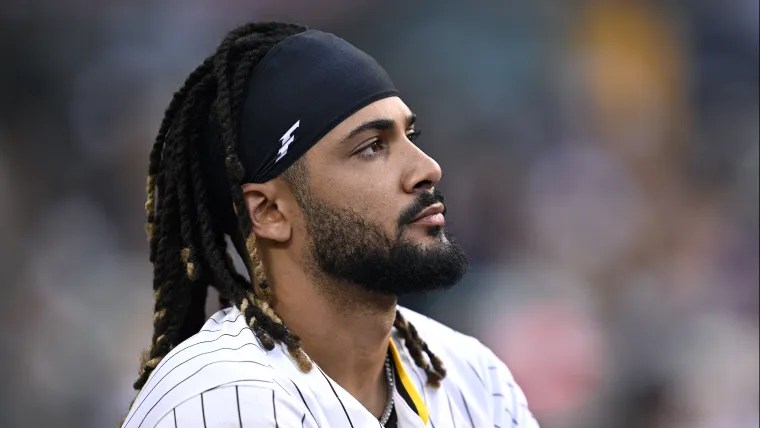
With a quarter of the 2026 MLB season behind us (crazy, I know), the Padres’ slugger has yet to hit his first home run of the season. His OPS is a measly .611. His wRC+ sits at 79, and his ISO is .049. For a player who averages one home run every 20 plate appearances over his career, the lack of power in Tatis Jr.’s bat is shocking to say the least. What’s going on with the San Diego superstar?
To preface this, I don’t necessarily think there’s something wrong with Tatis Jr. Yes, almost every single measurable offensive statistic is down compared to his career averages. Yes, his bat lacks the power that made him a centerpiece of the San Diego Padres organisation. Yes, his offensive fWAR sits at an eye-opening -3.5. Yet he’s still playing gold glove caliber defense, he’s still a threat on the basepaths, and he’s STILL Fernando Tatis Jr. So what’s going on at the plate?
The simple answer, particularly in relation to the lack of home runs, is that his launch angle is down. Here’s Tatis Jr.’s average launch angle over the course of his career.
| Year | Launch Angle |
|---|---|
| 2019 | 6.7° |
| 2020 | 8.7° |
| 2021 | 13.8° |
| 2023 | 11° |
| 2024 | 10° |
| 2025 | 9.4° |
| 2026 | 2.8° |
Does anything look strange to you? Yes, that 2026 number IS correct (I had to double check it myself). Although he’s hitting the ball just as hard as he has his entire career, he’s driving the ball into the ground far more often than he’s used to. His exit velocity is top 10% in baseball, and his hard hit percentage is in the 98th percentile. But these balls aren’t getting lifted like they should.
What’s the root cause of this? One could state that he’s simply on top of the ball and that’s why he’s hitting ground balls at a higher rate. Well, that’s not necessarily the case. His topped percentage is just under his career average, sitting at 32.4% for the current season. Instead, I’d like to offer a potential culprit; his swing path.
The general consensus around major league baseball is that the ideal attack angle is somewhere between 5-20 degrees, meaning that players are swinging up on the ball in order to lift it into the air. Hitters vary in their average attack angle, but if they’re generally somewhere between 5-20 degrees then the chance that they’re lifting the ball into the air is going to be very high. Tatis Jr.’s attack angle sits at 6 degrees for 2026, right at the bottom end of the ideal spectrum. In 2025, this angle was at 8 degrees. In 2024, it was at 10 degrees and even higher in 2023 at 12 degrees. In essence, it’s not that he’s topping baseballs. Instead, his bat path is flatter than it’s ever been which results in more ground balls and less fly balls. This is also evidenced by the fact that his ideal attack angle percentage is the lowest of his career (50%). His swing path is hampering him.
I’d like to offer another potential cause for Fernando Tatis Jr.’s lack of power, one that’s been echoed by hundreds of major league hitting coaches throughout baseball’s history; he’s late.
Over the course of Tatis Jr.’s career, he’s never hit to the opposite field more than 25% of the time. This year, he’s doing it nearly 32% of the time. Also over the course of his career, he’s never pulled less than 36% of batted balls. In 2026, he’s only pulling balls 23% of the time. His pulled ground ball rate is down, his opposite field ground ball rate is up. He’s only pulling fly balls 5.6% of the time, which is 6th worst among qualified hitters this year. On top of this, he’s hitting opposite field fly balls at a higher rate than he has in his entire career. He can’t get into his power because he’s late on pitches. For high contact hitters like Nico Hoerner or Tatis’ teammate Luis Arraez, this wouldn’t be a problem. But for power hitters like Tatis Jr. it represents a potential issue.
I can’t explain why he’s late, only Fernando himself can do that. Maybe he worked on letting the ball get deeper into the zone during the offseason. Perhaps he isn’t picking up the ball well out of the pitcher’s hand. Whatever the exact reason may be, the numbers seem to suggest that his timing is off. Let me preface this by stating that Tatis Jr.’s positioning in the box has stayed relatively the same. His depth is the same as it has been the last few years, and he’s chosen to slightly back off the plate this year but only by an inch. So this isn’t the cause, but he’s intercepting pitches later than average. Don’t believe me? Take a look at the table below.
| Year | Intercept vs. Front of Plate | Intercept vs. Center of Mass |
|---|---|---|
| 2024 | 3.7 inches | 30.1 inches |
| 2025 | 3.6 inches | 29.9 inches |
| 2026 | 2.4 inches | 28.7 inches |
In 2026, Tatis Jr. isn’t making contact out in front of his body like he’s used to. Sure, it may only be a little over an inch in difference, but when pitches are coming in at 100 mph in a game of inches, THIS inch surely matters. When the ball travels deeper into the zone, a hitter is more likely to spray it to opposite field.
The simple fact that Tatis Jr.’s timing is off is also evidenced by his attack direction. The MLB average attack direction is 2 degrees to the pull side. This aligns with modern-day thinking that players should be pulling balls more often to take advantage of their power. Fernando’s attack direction this season is 4 degrees to the opposite field. Again, he’s late to make contact and as a result he can’t lean into his power as often as he’s used to doing.
The ideal vision for a power hitter is someone who gets out in front of pitches to pull them, and lifts them into the air. Tatis Jr. is struggling to do either of these things, particularly compared to his career averages. I can’t explain exactly why this is the case, only the Padres superstar has those answers. Maybe it’s a changed approach at the plate to make more contact. Maybe it’s the fact that his stance is far more closed than it’s been in recent years. Maybe he’s not seeing pitches well at release and is therefore late to make the decision to swing. It could be any number of things, but the root cause of Fernando Tatis Jr.’s lack of power is twofold; he’s late to pitches and his swing is flatter. He’s hitting to the opposite field and he’s doing it on the ground, neither of which are good for a man who’s used to showcasing his power.
All statistics and metrics were pulled from FanGraphs, Baseball Reference, and Baseball Savant unless otherwise noted

Leave a Reply