
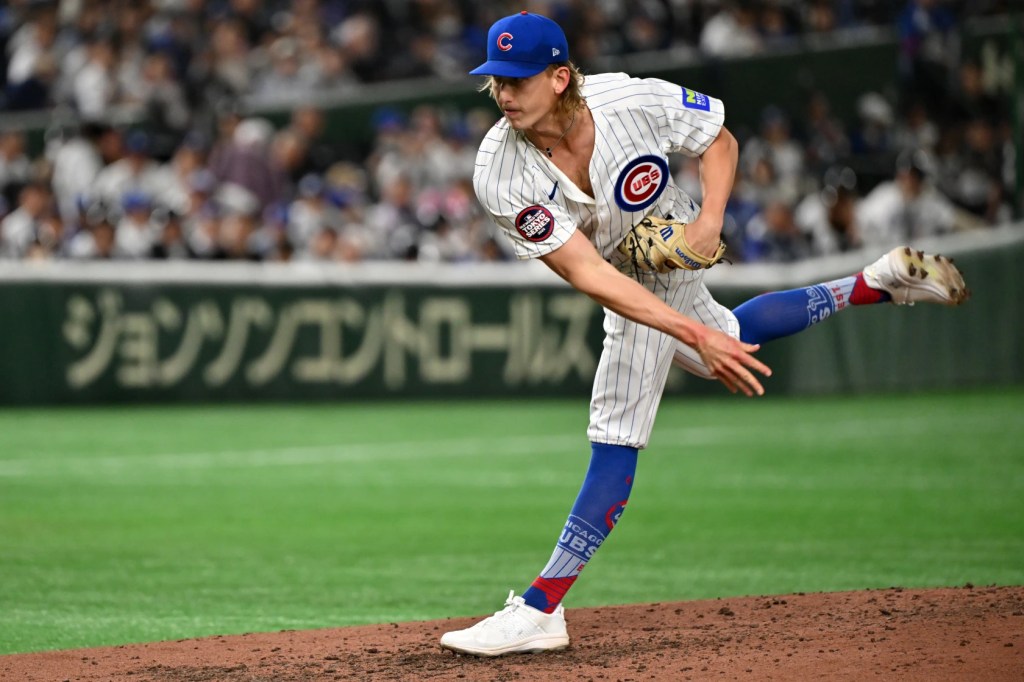
Entering the 2026 MLB season, if you wanted to pick the MVP of the Cubs’ pitching staff, you’d have a handful of options. Cade Horton, who made a run at the NL Rookie of the Year award last year. Matthew Boyd, an All-Star in 2025. Edward Cabrera, a powerful arm with one of the best changeups in baseball. Shota Imanaga, who had a rough 2025 but has continued to be a reliable arm for the North Siders. Perhaps even Caleb Thielbar and Daniel Palencia would get some votes in the bullpen. One name that nobody would have put forth? Ben Brown.
Coming into this season, nobody was even sure if Ben Brown would make the Opening Day roster. The starting rotation was loaded with talent, and the Cubs have been committed to developing Brown as a starter instead of relegating him to the bullpen. With Cade Horton undergoing season ending elbow surgery, Matthew Boyd dealing with a slew of injuries, and Justin Steele suffering a setback during his rehab, the opportunity was there for Brown to prove something he hadn’t in his first two years with the Cubs.
2024 wasn’t a poor season for Brown by any means. He posted a 3.58 ERA with a 1.08 WHIP. His strikeout percentage and whiff rates were near the top of the league. He threw hard and had a versatile knuckle-curve, but that was it. It’s hard to be a starting pitcher if you only have two pitches to offer, and it showed. Brown was in the bottom 1% of all pitchers in terms of exit velocity, and his hard hit percentage wasn’t any better. Opponents were barreling balls at an alarming rate and his ground ball rate was abysmal (37.7%). The 2025 season was even worse for the young right-hander and it was clear that he wouldn’t be able to maintain a presence in the rotation with just two pitches. So he put the work in during the off-season. Many people, including myself, thought that his changeup would finally become a pitch that he felt comfortable throwing. Instead, he added an entirely new pitch to his repertoire; a blazing two-seam fastball.
With the two-seam fastball added to his arsenal, Brown has been the best pitcher on the Cubs staff this season. Don’t believe me? He leads the team in almost every meaningful expected statistic; xwOBA, xBA, xSLG, xISO, and only Imanaga has a higher xOBP (barely). His barrel percentage sits at 6%, a far cry from his 2024 and 2025 seasons where he sat over 10%. Perhaps most importantly, his ground-ball rate is 53.4%, which is good for top 10% in the majors. It certainly helps that he has regained command of his curveball and has been able to get more depth out of it. As it stands he has the best curveball in the MLB, as evidenced by its +8 Run Value, which is 2 points higher than the next closest pitcher in Aaron Nola.
And yet I believe his curveball wouldn’t look nearly as good as it does without the addition of the two-seam fastball. Brown was limited prior to its addition, particularly against right-handed hitters. In the previous two seasons, he threw his four-seam 57% of the time to righties. This season? He’s throwing it only 20% of the time. He instead relies on his new two-seam 40% of the time, and he uses the pitch like a reverse cutter – driving it in on the hands of right-handed hitters. This strategy has proved successful, as he’s produced an astonishing .74 WHIP against righties.
Baseball Savant has the pitch listed as a sinker, and by sinker standards it may be somewhat underwhelming. It doesn’t sink, as evidenced by the fact that it has nearly 6 inches less drop than the average sinker. But Brown isn’t using it as a sinker. He’s developed a true two-seam fastball that allows him to work east to west when paired with his four-seam, and he throws it over two MPH harder than the average MLB sinker. He gets frisbee-like movement with the pitch and it’s clearly making hitters uncomfortable. On average, there’s a 7 inch horizontal difference between his two-seam and his four-seam. That’s a bigger difference than Nolan McLean has between his two fastballs (although Nolan gets far more sink out of his pitch, and also offers a cutter).
The point that I’m trying to make is that Ben Brown has found an organic way to lower his hard hit rate and barrel percentage. He didn’t need to reinvent his four-seam, and he certainly hasn’t needed to develop his off-speed pitch (which he still only throws 6% of the time). Instead, he decided to add a two-seam grip and throw the ball just as hard as he does with his four-seamer. He doesn’t get crazy amounts of spin with the pitch (bottom third in baseball), and it actually has less spin than his four-seam fastball does. Yet the biggest priority with Brown has been finding a way to keep hitters from sitting on his four-seam; and the two-seam addresses this priority wonderfully.
In 2025, Brown’s four-seam fastball had a run value of -11 (-1.2 RV/100). Opponents were slugging .526 on the pitch and it had a hard hit rate over 50%. This year, his four-seam has a run value of 0 (0.1 RV/100) and opponents are slugging .333 against it. It’s still early, but the addition of the two-seam fastball complements his four-seam to ensure that he doesn’t have to throw it as often, and hitters can’t sit on the pitch like they used to. It’s not that his four-seam has gotten better. He’s still getting the same whiff rates that he was last year (15.3% vs 14.8%), and his strikeout rate with the pitch has ticked up marginally (16.9% vs 14.3%). However, his hard hit rate on the four-seam has dropped by 6% and opponents’ wOBA against the pitch has dropped by over 60 points.
Overall, Ben Brown’s new two-seam fastball has solved one of the biggest issues that has plagued his young career; hard contact. Against the two-seam, opposing batters have a hard hit rate of 34.5% – the lowest rate of any pitch in Brown’s arsenal. Teams around the league have already begun to adjust to the young right-hander’s new pitch, but it has proven to be effective in limiting hard contact thus far. While he’s certainly due for some regression to the norm, it’s clear that the new weapon has benefitted Brown and a Cubs rotation that has been ravaged by injuries.
All statistics and metrics were pulled from FanGraphs, Baseball Reference, and Baseball Savant unless otherwise noted

Leave a comment